

Abstract
Emerging photovoltaic technologies such as perovskites, thin-film absorbers, and multi-junction tandems exhibit strong wavelength dependent electrical response and degradation behavior. As a result, photovoltaic characterization is increasingly sensitive to the spectral content, temporal stability, and thermal load of the illumination source. Conventional broadband solar simulators based on arc lamps and optical filtering provide limited flexibility in these parameters and can introduce measurement bias, particularly in stability testing and tandem device characterization.
This work presents a multisource LED-based solar simulation approach as a new concept for photovoltaic measurement and test methodology. Independently addressable narrowband LED channels spanning the ultraviolet, visible, and near-infrared regions enable programmable synthesis of standard solar spectra (e.g., AM1.5G, AM0) as well as controlled spectral perturbations relevant to advanced device architectures.
The solid-state nature of LED illumination provides high short- and long-term temporal stability while reducing parasitic heating effects that can obscure intrinsic degradation mechanisms in temperature-sensitive materials. The relevance of wavelength-resolved illumination control is discussed in the context of perovskite and tandem photovoltaics, where sub-cell current matching, spectral mismatch, and thermally induced artifacts can significantly affect measured performance and stability outcomes. The results highlight the need to complement traditional spectral match metrics with greater emphasis on spectral coverage, deviation, and dynamic control when characterizing next-generation photovoltaic devices.
Introduction
Tandem and multijunction photovoltaic devices introduce an additional challenge for solar-simulator characterization: different junctions respond to different portions of the incident spectrum. A light source may therefore show excellent spatial uniformity under broadband operation, while its uniformity within a narrower wavelength range relevant to an individual junction may be different.
This work investigates whether the G2V Optics Sunbrick LED Solar Simulator maintains high spatial uniformity when its spectrum is evaluated over wavelength regions relevant to different tandem-junction configurations.
Background & Measurement Challenge
Multisource LED solar simulators provide independent control over individual wavelength channels, allowing the incident spectrum to be tailored for different photovoltaic technologies and measurement conditions. Because the full-spectrum output of an LED solar simulator is produced by the overlapping contributions of multiple wavelength channels, adjusting their relative output can also change the spatial irradiance distribution. As a result, a light source that exhibits excellent spatial uniformity over the full spectrum may not necessarily maintain the same level of uniformity over narrower, junction-relevant spectral ranges.
For tandem characterization, where the top and bottom junctions respond to different spectral regions, it is important that acceptable spatial uniformity is maintained within the relevant analysis windows of the different subcells and tandem architectures.
The objective of this work is to determine whether the G2V Optics Sunbrick LED solar simulator maintains Class A/A+ spatial uniformity within these junction-relevant spectral windows.
Why Junction-Relevant Spectral Windows Matter
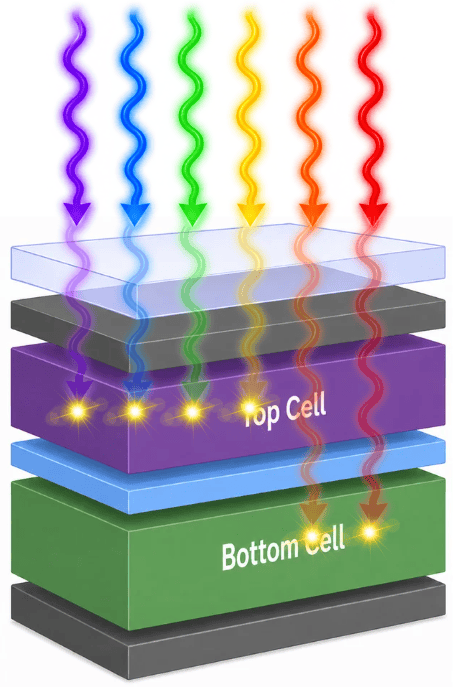
In a tandem solar cell, the individual subcells are designed to respond to different wavelength regions. The higher-bandgap top junction primarily utilizes shorter-wavelength photons, while longer-wavelength photons can pass through to the lower-bandgap bottom junction.
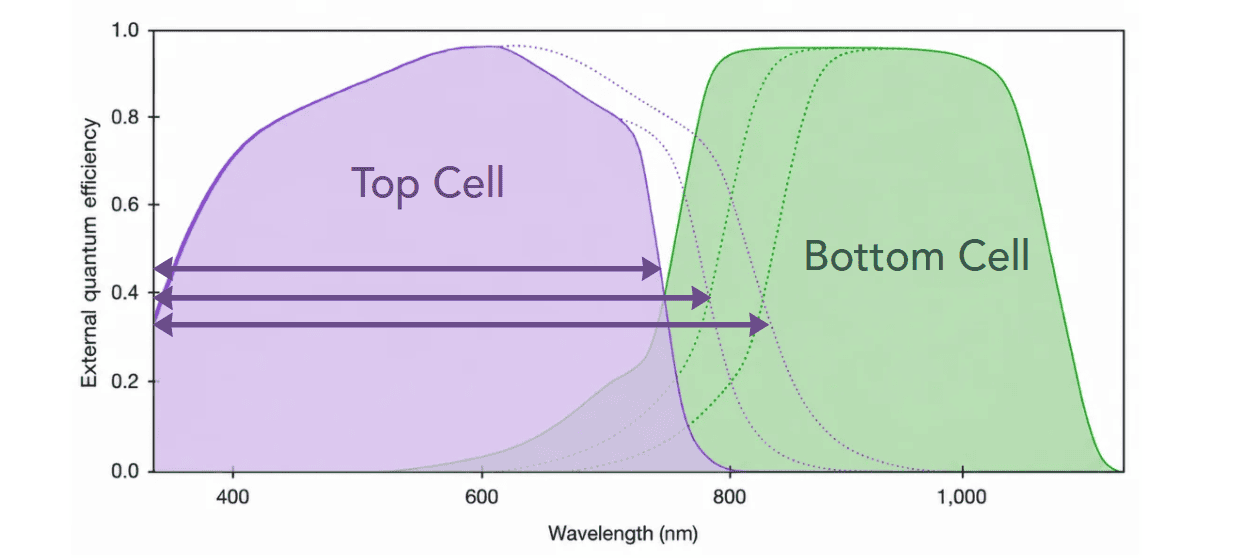
Because the Sunbrick uses multiple independently controlled LED wavelength channels, different spectral regions can be reproduced or analyzed separately. However, changing the active wavelength range also changes the combination of LED channels contributing to the illumination field. This raises an important question:
Does the spatial uniformity of the light source remain acceptable when only the spectral region relevant to a particular tandem junction is considered?
To investigate this, three representative tandem architectures were selected:
- Perovskite-Perovskite tandem: Top-junction window 300–680 nm; bottom-junction window 700–1200 nm.
- Perovskite-CIGS tandem: Top-junction window 300–700 nm; bottom-junction window 740–1200 nm.
- Perovskite-Silicon tandem: Top-junction window 300–740 nm; bottom-junction window 760–1200 nm.
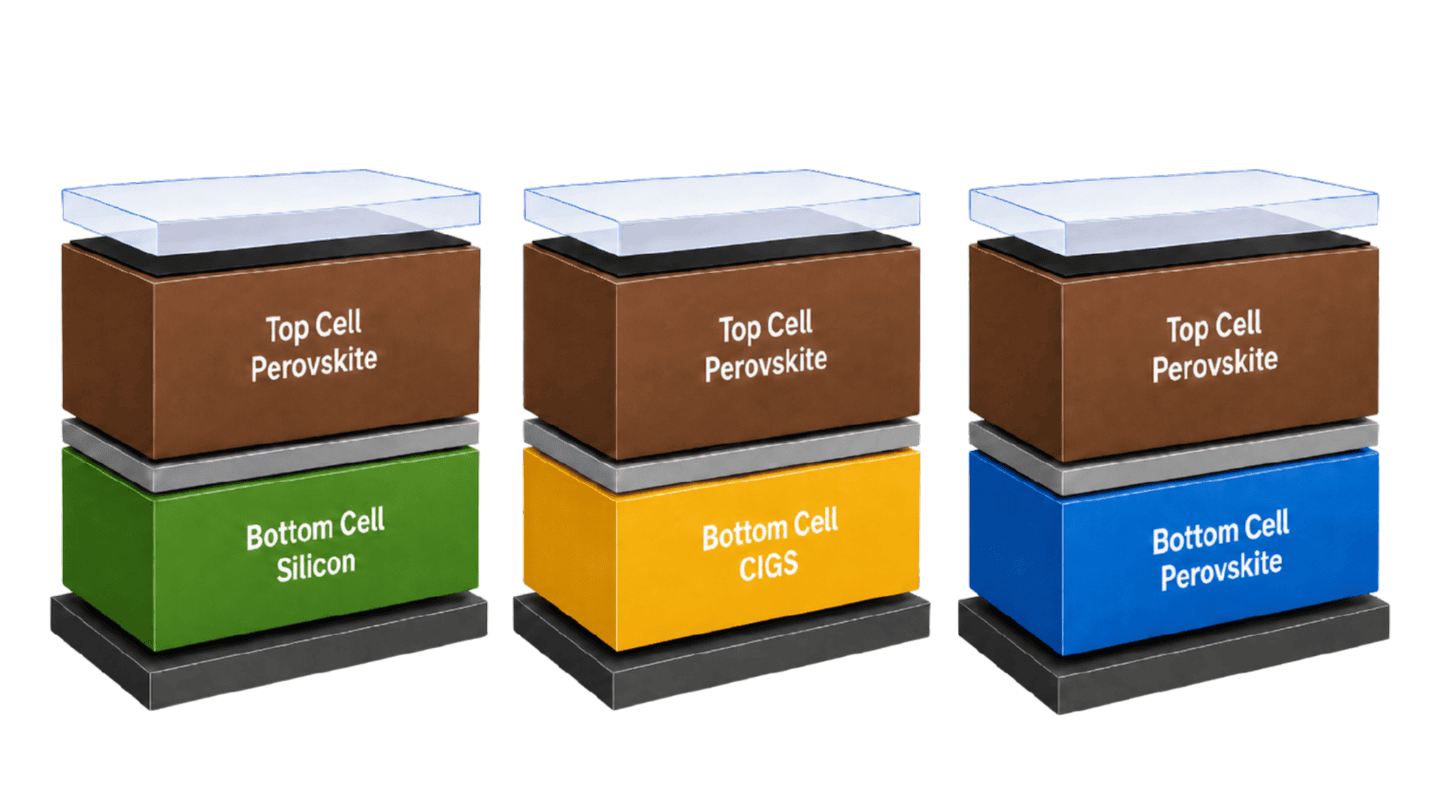
Across the three cases, the perovskite top-junction window was progressively extended toward longer wavelengths, while the corresponding bottom-junction window was adjusted accordingly. Each case was associated with a representative tandem architecture whose bottom-cell spectral response was broadly compatible with the selected wavelength range.
These wavelength ranges were defined specifically as junction-relevant analysis windows for spatial-uniformity testing. They are not intended to represent the exact EQE boundaries of the individual materials, since practical device response depends on composition, bandgap, thickness, architecture, and fabrication conditions.
Experimental Methodology
Experimental Setup
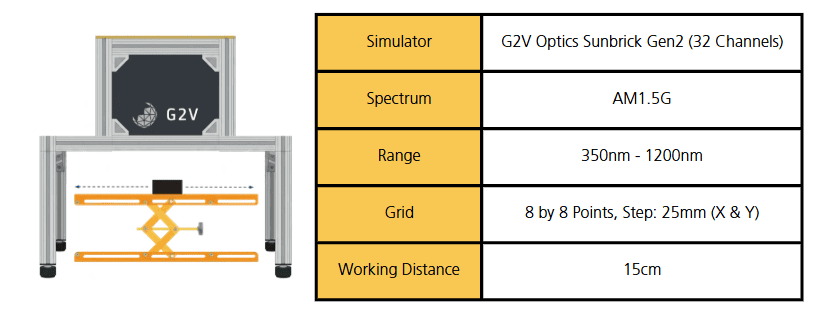
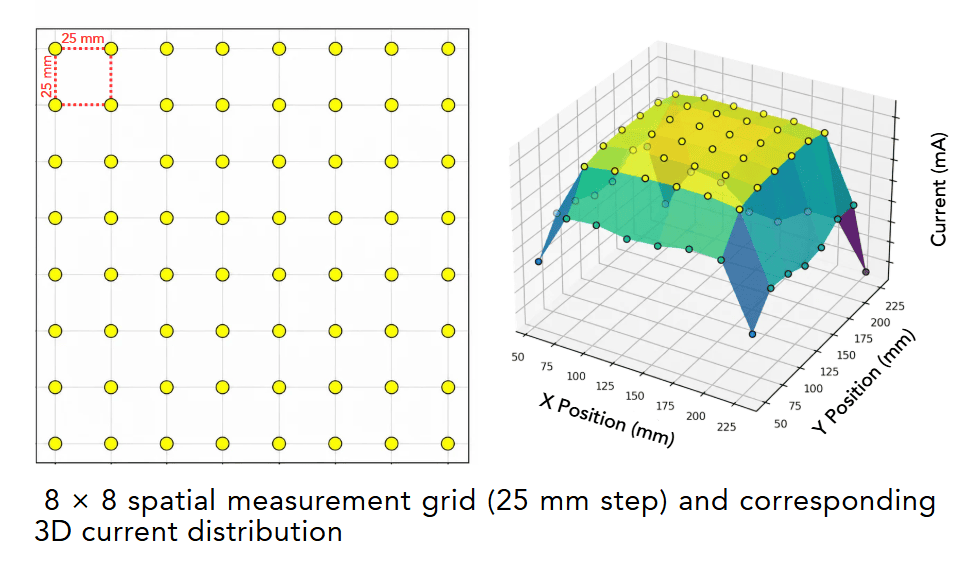
A custom-built X–Y gantry was used to map spatial uniformity. The Sunbrick LED solar simulator was positioned at a fixed 15 cm working distance, while a calibrated RERA reference cell connected to an SMU was scanned across a nominal 20 × 20 cm area. Measurements were collected on an 8 × 8 grid (64 points) with 25 mm spacing in both X and Y, giving a 17.5 × 17.5 cm center-to-center scan span.
Spectral Design
The simulator was operated under AM1.5G over 350–1200 nm using 23 independently controlled LED wavelengths (32 Channels). Junction-relevant wavelength windows were selected based on spectral-response ranges commonly reported in the scientific literature for each photovoltaic technology and subcell. Spatial uniformity was then evaluated separately for the full spectrum and for each selected spectral window.
Photocurrent Measurement and Spatial Uniformity
At each X-Y position, the photocurrent generated by the calibrated RERA reference cell was measured using an SMU. Because the reference-cell photocurrent is proportional to incident irradiance under fixed spectral conditions, the measured current was used to map the relative spatial irradiance distribution.
Spatial non-uniformity was calculated directly from the maximum and minimum measured photocurrents:
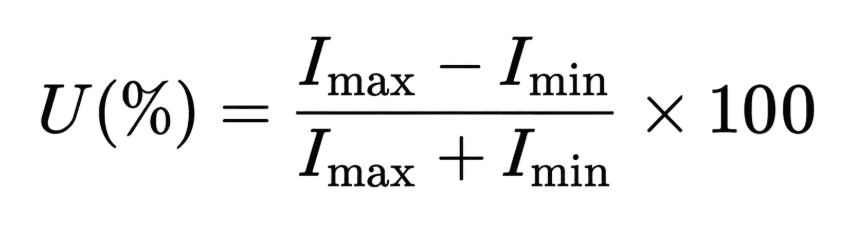
This procedure was repeated for the full-spectrum condition and for each junction-relevant spectral window, allowing the spatial performance of the simulator to be compared as the evaluated wavelength range changed.
Key Findings
The results show that changing the spectral region used for tandem-junction analysis did not substantially degrade the spatial performance of the Sunbrick.
Across all three representative tandem configurations:
- Class A spatial uniformity was maintained over 15 × 15 cm.
- Class A+ spatial uniformity was maintained over 10 × 10 cm.
- High spatial uniformity was preserved for both top- and bottom-junction spectral windows.
- Comparable performance was also observed under the full-spectrum operating condition.
These results are important because broadband spatial uniformity alone does not necessarily guarantee equivalent performance after the spectrum is narrowed or reweighted. For multisource LED systems, the spatial distribution is produced by the combined contribution of many wavelength channels, so spectral tuning can potentially modify the illumination pattern.
Conclusion
Across three representative tandem spectral scenarios, the G2V Optics Sunbrick LED Solar Simulator maintained consistent spatial performance as the wavelength regions relevant to the top and bottom junctions were changed. Despite spectral tuning, all evaluated junction-relevant bands remained within the Class A spatial non-uniformity criterion over 15 × 15 cm, while the central 10 × 10 cm region achieved Class A+ performance.
The results demonstrate that high spatial uniformity can be preserved not only under broadband illumination but also when the source is evaluated within substantially different wavelength ranges relevant to individual tandem junctions. This is particularly valuable for advanced photovoltaic characterization, where the spectrum may need to be adjusted according to the spectral response and bandgap of each subcell.
More broadly, the combination of independent wavelength control and verified spatial uniformity provides a flexible platform for investigating tandem and multijunction devices without requiring a different light-source configuration for every cell architecture. The same multisource LED system can therefore be adapted to different junction-relevant spectral conditions while maintaining controlled and reproducible illumination across the measurement
References:
- 1- Diercks, Alexander, et al. “Close-space sublimation as a versatile deposition process for efficient perovskite silicon tandem solar cells.” Nature Energy (2026): 1-12.
- 2- Lim, Jaekeun, et al. “All-perovskite tandem solar cells: from fundamentals to technological progress.” Energy & Environmental Science 17.13 (2024): 4390-4425.
- 3- Giuliano, Giuliana, et al. “Semitransparent perovskite solar cells for building integration and tandem photovoltaics: design strategies and challenges.” Solar Rrl 5.12 (2021): 2100702.