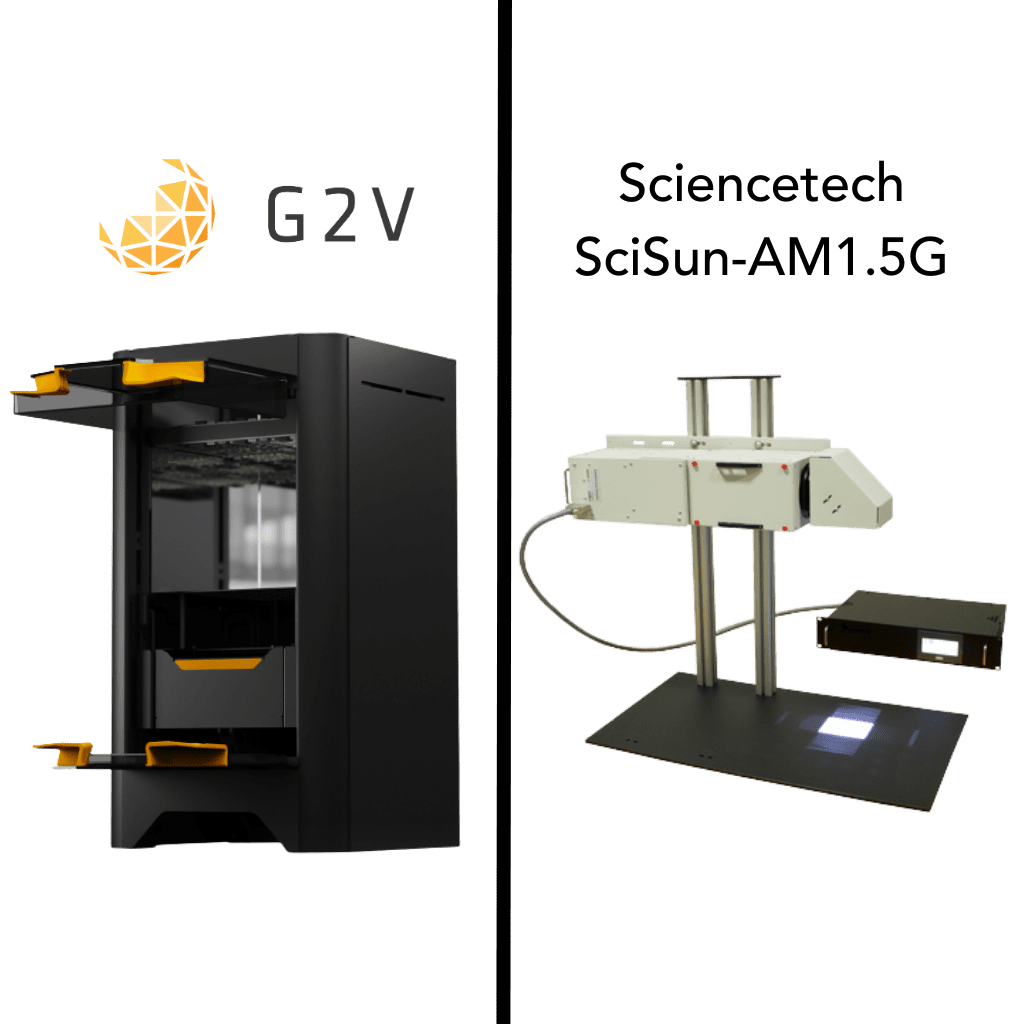
When precision matters, not all solar simulators deliver.
This side-by-side comparison of the G2V Sunbrick and Holmarc’s solar simulator reveals key differences in IEC standards and automation, so you can choose the solution that keeps pace with your research, not your maintenance schedule.
| Feature | G2V Sunbrick | Holmarc Solar Simulator | Questions To Ask Yourself |
|---|---|---|---|
| Area of Illumination | 15 cm × 15 cm | 5 cm diameter | Will my Device Under Test (DUT) increase in size as my research progresses? |
| Spectral Range | 350 nm – 1200 nm | 300 nm – 1100 nm | Do I need UV photons starting at 300 nm or NIR coverage beyond 1100 nm, or will the power in these areas be sufficient? |
| Spectral Control | 32 tunable channels | Fixed spectrum using AM1.5G filter (Xenon lamp) | Will I need to simulate AM1.5G, AM0, or custom conditions? |
| IEC 60904-9 Compliance | Class A+A+A+ | Class B (Spectral Match), Class C (Uniformity), Class B (Stability) | Do I need certified, high-accuracy performance across all IEC categories? What problems will I have with lower Class uniformity performance? |
| Spectral Deviation | <25% | Does not report | How closely does the spectrum need to match real sunlight for my application? |
| Spectral Match | < ±12.5% | ±40% | How much spectral mismatch can my application tolerate before it affects measurement accuracy or material performance? |
| Long-Term Temporal Stability | <2% | <2% | How sensitive are my experiments to light stability over time? |
| Spatial Uniformity | <1% | <10% | Do I need consistent irradiance over the full sample surface? Could spatial variation compromise my data? |
| Lifetime | 10,000+ hours | Shorter, due to Xenon lamp degradation | Will long-term consistency reduce repeat testing or recalibration? Do I require stability over hours, days, or longer? |
| Software & API | GUI + Python API | Basic GUI; optional PC control via RS232-USB | Will I need automation, scripting, or lab instrument integration? |
| Maintenance | No consumables; minimal maintenance | Requires Xenon bulb replacement and possible optical filter upkeep | How important is minimizing maintenance interruptions? Does my current budget factor in monthly ongoing costs for bulbs? |
| Price Point | ~$56.00/cm² (Class A+A+A+ over 225 cm²) | ~$464/cm² (Class BCB over ~19.6 cm²) | Does the price reflect full system capability and long-term value? Will I need to upgrade later? |
When comparing the G2V’s Sunbrick LED Solar Simulator and Holmarc HO-SC-SS300C Xenon Solar Simulator, it’s essential to consider their technical specifications, how their features align with your research needs, and the unavoidable value comparison.
The Sunbrick offers a larger area of illumination (15 cm × 15 cm), a broad tunable spectrum across 32 channels, and integration-ready software with a Python API, supporting more complex and evolving experimental setups.
While the Holmarc Solar Simulator provides a cost-effective solution with a 300W Xenon lamp and basic features, it has limitations in spectral control, spatial uniformity, temporal stability, and lacking automation capabilities.
Both systems meet certain IEC standards, but the Sunbrick achieves higher compliance levels (Class A+A+A+) across all parameters and at a final price on par with the Holmarc xenon solar simulator.



















When precision matters, “good enough” isn’t. Leading institutions in photovoltaics, materials science, and photochemistry choose G2V because their research demands light they can trust, not a filtered approximation.
Whether you’re:
Validating next-gen solar cells
Testing real-world conditions
Or creating new photocatalytic materials
The Sunbrick delivers Engineered Sunlight™ with complete control, no filters, no drift, no compromises.
Finding a consistent format of information comparing solar simulators and other alternatives isn’t easy. Our articles are designed to consolidate the information and keep you from needing to explore endless pages of search results
Knowledge Base
Explore our knowledge base to learn more about customers’ work in the STEM field, the IEC standards, and the physics properties of light and how they apply to different applications. Our knowledge base is designed to make finding information on solar simulation faster than light.
In our modern era, nearly every industry has standards that set baselines for ensuring its associated products are safe and suitable to perform intended tasks. Solar simulation – reproducing sunlight – is no different, having standards that specify the requirements for solar simulators, and...
For the latest information on the Sinton FCT-650Se please download the Advanced Characterization Specs. Included is everything you need to know about the Sinton/G2V advanced characterization bundle.
If you would like to know more please get in touch.