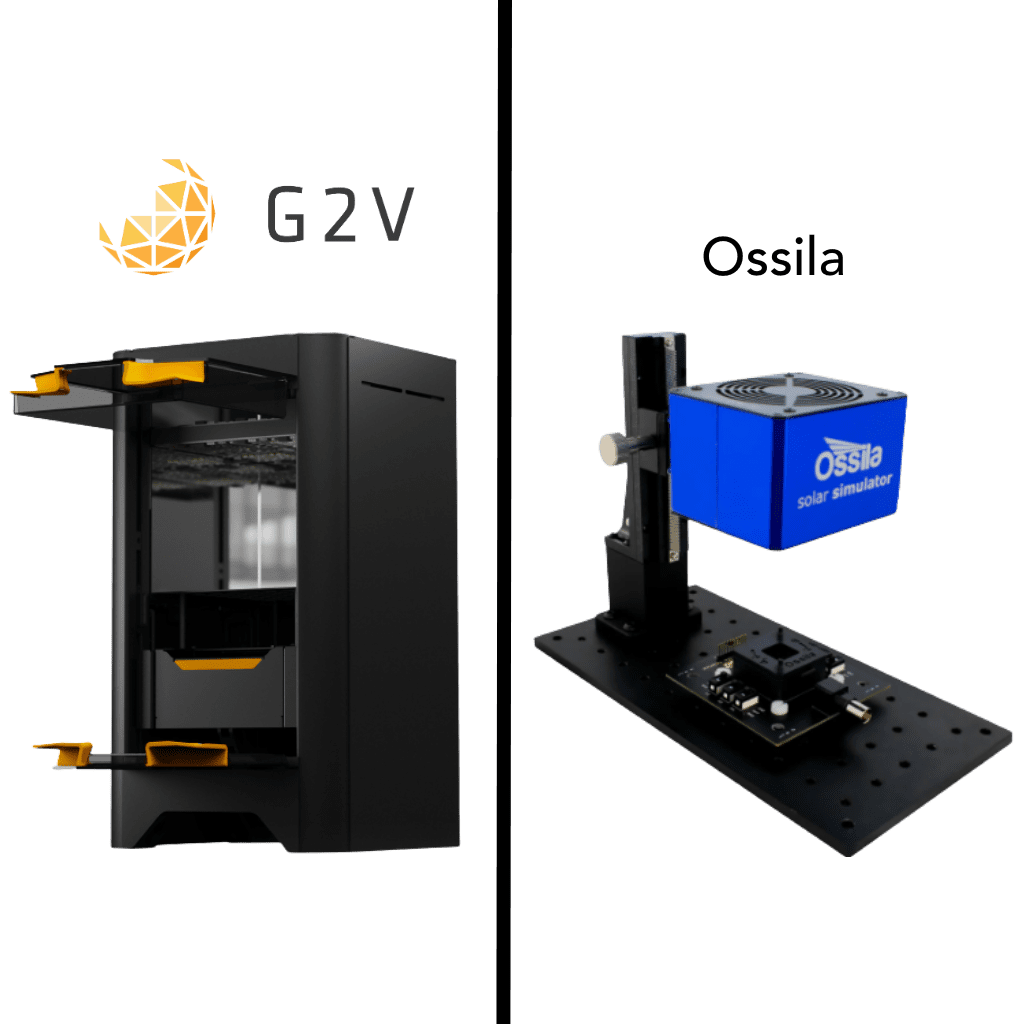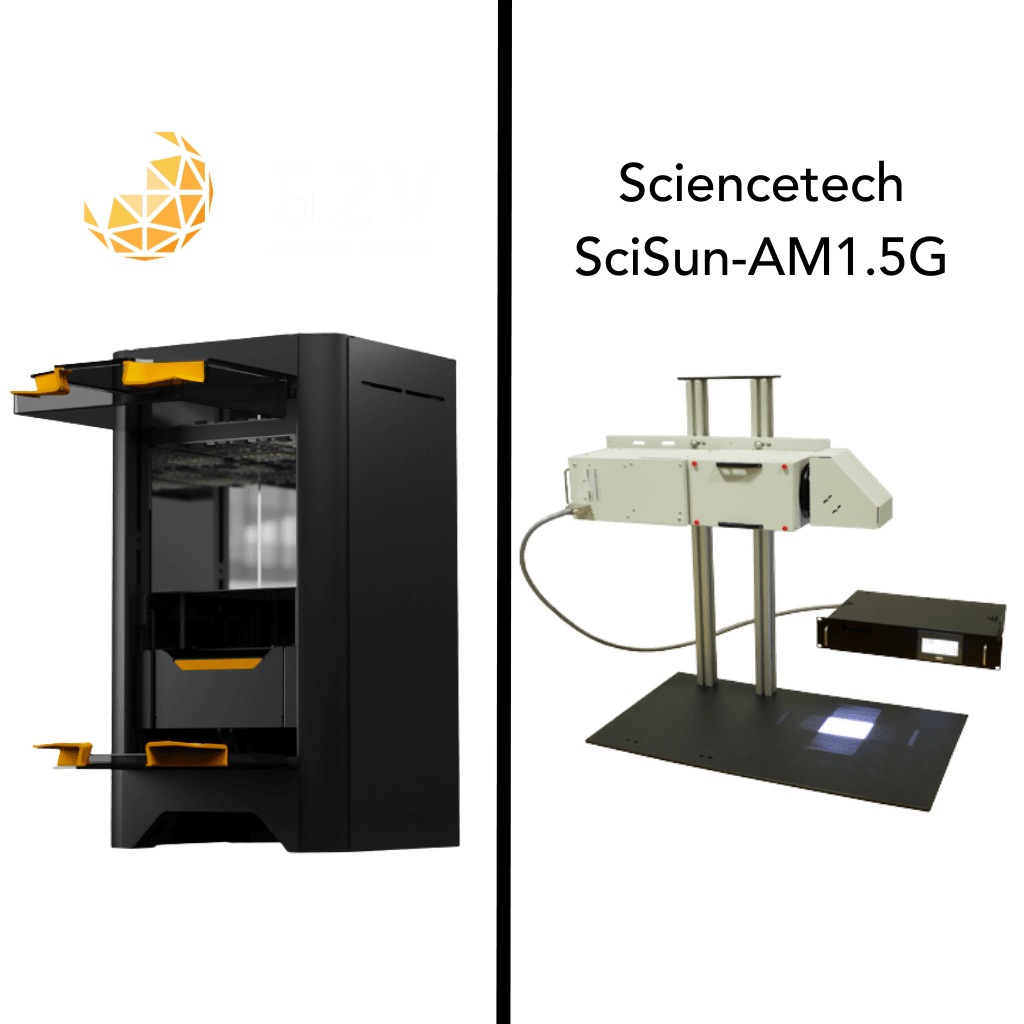

When precision, flexibility, and scalability are paramount, not all Class AAA solar simulators are created equal. This side-by-side comparison of the G2V Sunbrick and ScienceTech SciSun-AM1.5G reveals key differences in spectral control, uniformity, automation, and beyond.
| Feature | G2V Sunbrick | ScienceTech SciSun-AM1.5G | Questions To Ask Yourself |
|---|---|---|---|
| Area of Illumination | 15 cm × 15 cm | 5 cm × 5 cm (Class AAA zone) | Will my sample size or test requirements grow as my research progresses? |
| Spectral Range | 350 nm – 1200 nm | 300 nm – 1100 nm (Xenon with AM1.5G filter) | Do I need coverage beyond 1100 nm or programmable profiles? Wil I need to filter out more of the spectrum for future research? |
| Spectral Control | 32 tunable LED channels | Fixed spectrum | Will I need to match non-standard or future testing profiles? |
| IEC 60904-9 Compliance | Class A+A+A+ (2020) | Class AAA (2007) | Am I publishing or certifying under the latest solar simulation standards? |
| Temporal Stability | <2% (over 100s of hours) | 0.13% (over 3.5 seconds) | Can I maintain test consistency over hours or days? |
| Spatial Uniformity | <1% | 1.4% | Do my samples need uniform illumination across every cm²? |
| Maintenance | No consumables | Requires periodic Xenon lamp replacement | How much downtime or recurring cost can I afford? What are the cost of bulb replacements? How many bulbs per year will I need? |
| Software & Automation | Full API (Python/REST), IV integration | Optional PC software (manual or TTL control) | Will I need to automate or run scripts across multiple instruments? |
| System Footprint | Modular, compact enough to fit on a desktop or lab bench | Free-space, optical rail layout | Does my setup require space efficiency? |
| Price per cm² | ~$56/cm² (225 cm² area) | ~$379.00 - $479.00/cm² (25 cm² area) | Am I paying more for less? What’s the real cost per usable test area? |
While both systems offer at least Class AAA performance, the G2V Sunbrick delivers significant tunability, automation, and certified area size advantages. With 32-channel spectral control and Class A+A+A+ compliance across the 15 × 15 cm area, it’s engineered for high-precision, evolving research needs.
While certified and well-built, the ScienceTech SciSun-AM1.5 G offers a fixed spectrum, a smaller test area, and a lamp-based design requiring periodic replacement and recalibration. It’s suited to basic workflows.
The G2V Sunbrick offers a more scalable and cost-effective path forward for labs prioritizing future-proofing, automation, and minimized downtime.



















Top research labs, aerospace agencies, and photovoltaics innovators choose G2V because their work demands repeatability, compliance, and control. In fields where even a 2% deviation can invalidate results, “close enough” simply isn’t.
Whether you’re:
Validating next-gen solar cells
Investigating novel materials or light-dependent reactions
Automating precision photonic workflows
The G2V Sunbrick gives you engineered sunlight without the DIY workarounds, bulb swaps, or uncertainty.
Finding a consistent format of information comparing solar simulators and other alternatives isn’t easy. Our articles are designed to consolidate the information and keep you from needing to explore endless pages of search results
Knowledge Base
Explore our knowledge base to learn more about customers’ work in the STEM field, the IEC standards, and the physics properties of light and how they apply to different applications. Our knowledge base is designed to make finding information on solar simulation faster than light.
In our modern era, nearly every industry has standards that set baselines for ensuring its associated products are safe and suitable to perform intended tasks. Solar simulation – reproducing sunlight – is no different, having standards that specify the requirements for solar simulators, and...