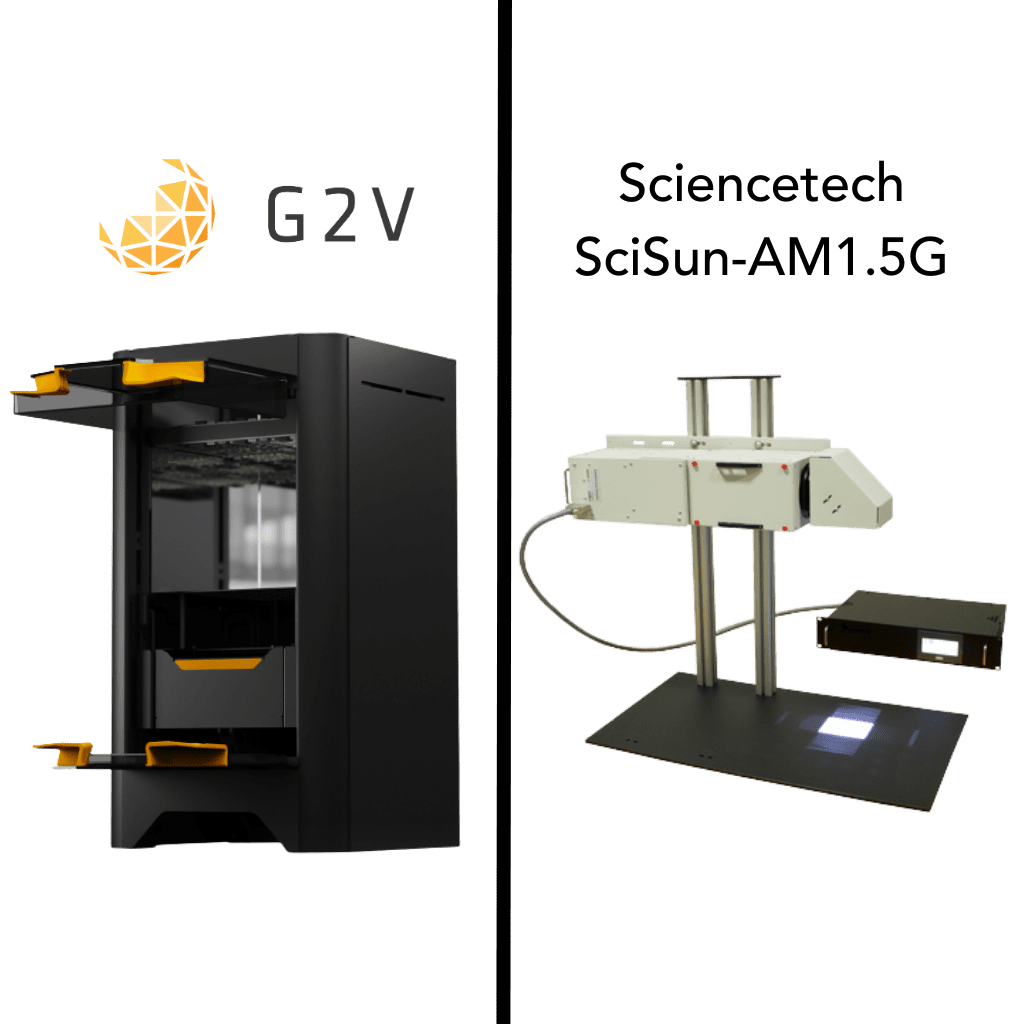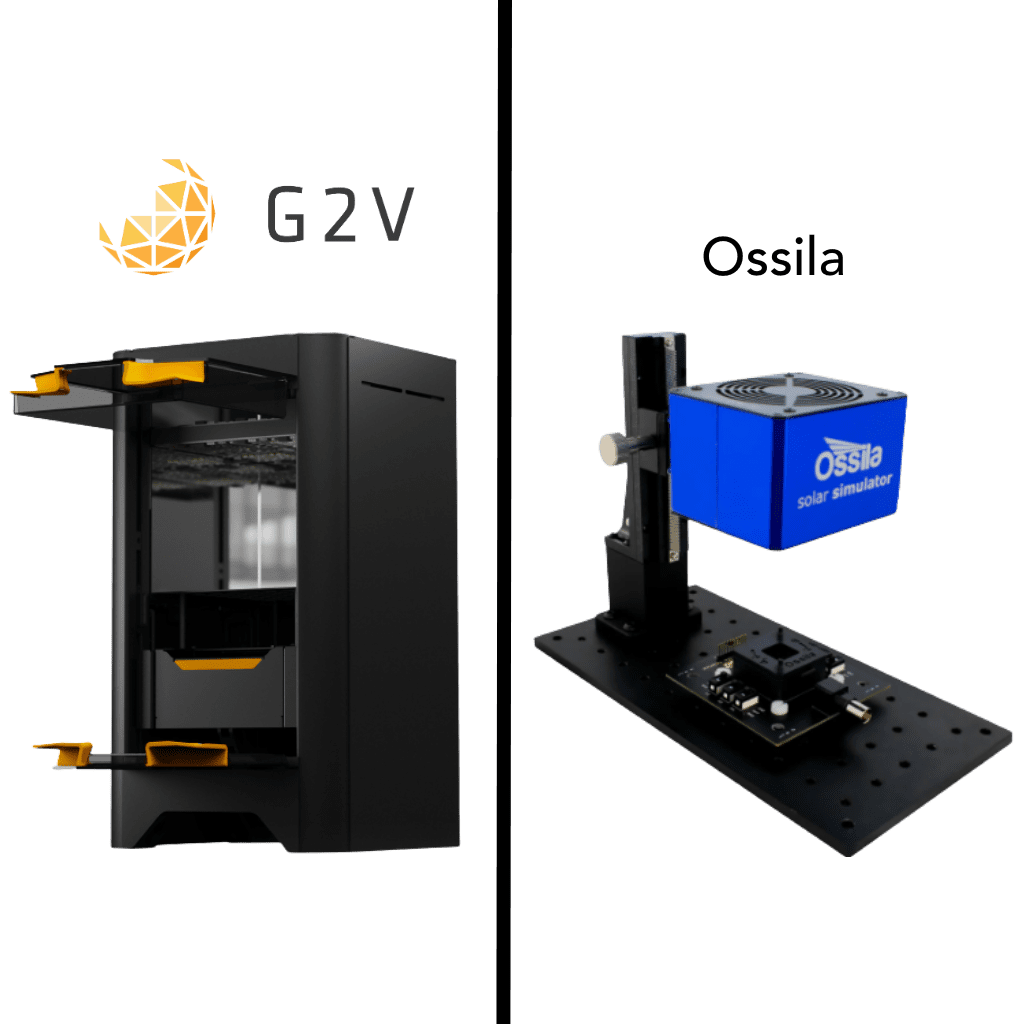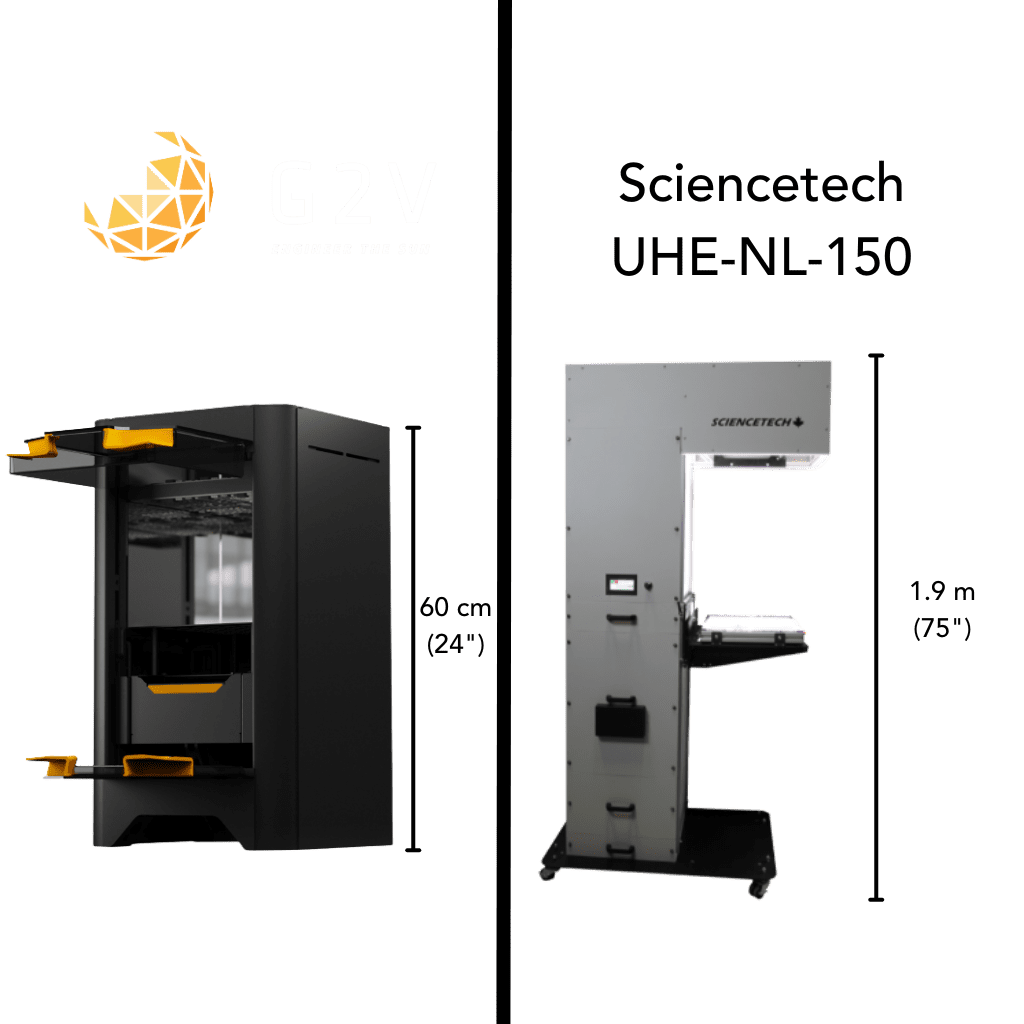

Consistent light matters as much as spectral match when you’re testing cutting-edge photovoltaics or materials science. This comparison shows how the G2V Sunbrick and Sciencetech UHE-NL-150 differ in tunability, footprint, automation, and ongoing usability.
| Feature | G2V Sunbrick | Sciencetech UHE-NL-150 | Questions To Ask Yourself |
|---|---|---|---|
| Illumination Area | 15 cm × 15 cm (225 cm²) | 15 cm × 15 cm (Class A target area) | |
| Spectral Range | 350 nm – 1200 nm | 300 nm – 1100 nm | Does my application require coverage beyond 1100 nm or programmable tuning? |
| Spectral Control | 32 Tunable LED Channels | Fixed Spectrum (Xenon + AM1.5G filter) | Do I need AM0 performance or any other unique spectrum? |
| IEC 60904-9 Compliance | Class A+A+A+ (2020) | Class A (2007 standard) | Do I require compliance with the latest IEC 60904-9:2020 revision? |
| Temporal Stability | <1% (over 10,000 hours) | Class A (increasing variance with increased age of bulb) | How critical is long-term light consistency for my data? Do I plan on conducting long time testing? |
| Automation & API | Python API, IV integration | Manual or TTL shutter, optional PC GUI | Can I automate IV sweeps, light cycles, or stress tests? |
| Footprint | Compact, modular enclosure | Floor mounted or on rolling mount | Do I need this to fit inside a fumehood? How much lab space do I have? |
| Maintenance | No consumables, LED-based | Requires 1000W Xenon bulb replacement | Can I afford downtime or recalibration cycles? What are the costs of bulbs per year? |
| Spectral Stability | <2% (over 10,000 hours) | Varies with bulb aging and usage | How critical is long-term light consistency for my data? Do I plan on conducting long time testing? |
| Price per cm² | ~$56/cm² (225 cm²) | ~$100–$150/cm² (based on estimates) | Is my budget going toward precision, or infrastructure overhead? |
While both systems offer a 15 cm × 15 cm illumination area and Class A performance, the G2V Sunbrick stands apart with its fully programmable 32-channel LED architecture, Class A+A+A+ compliance to the latest IEC 60904-9:2020 standard, and automation-ready design. Its compact form factor and zero-maintenance operation make it ideal for modern labs prioritizing throughput, repeatability, and precise spectral control.
The Sciencetech UHE-NL-150, by contrast, relies on a 1000 W Xenon lamp with AM1.5G filtering, delivered through a free-space optical rail system. While it provides broad-spectrum illumination and a large target area, it lacks spectral tunability, modern API integration, and requires regular bulb replacements that introduce variability and downtime.
For teams focused on scalable, future-proof solar simulation, whether for photovoltaics, materials science, or photochemistry, the G2V Sunbrick delivers engineered sunlight without traditional Xenon systems’ bulk, drift, or manual workarounds.
















Top-tier labs in aerospace, photovoltaics, and materials science are turning to the G2V Sunbrick because they need more than just light; they need control. In research where a 2% deviation can invalidate months of work, bulky Xenon systems with drifting spectra and manual control don’t cut it.
Whether you’re:
Validating next-gen solar cell performance
Simulating real-world solar conditions across custom spectra
Or automating precise, long-duration optical tests
The Sunbrick delivers Engineered Sunlight™ without the optical benches, bulb changes, or setup headaches. Just stable, repeatable, programmable light. Wherever and whenever you need it.
Finding a consistent format of information comparing solar simulators and other alternatives isn’t easy. Our articles are designed to consolidate the information and keep you from needing to explore endless pages of search results
Knowledge Base
Explore our knowledge base to learn more about customers’ work in the STEM field, the IEC standards, and the physics properties of light and how they apply to different applications. Our knowledge base is designed to make finding information on solar simulation faster than light.
In our modern era, nearly every industry has standards that set baselines for ensuring its associated products are safe and suitable to perform intended tasks. Solar simulation – reproducing sunlight – is no different, having standards that specify the requirements for solar simulators, and...