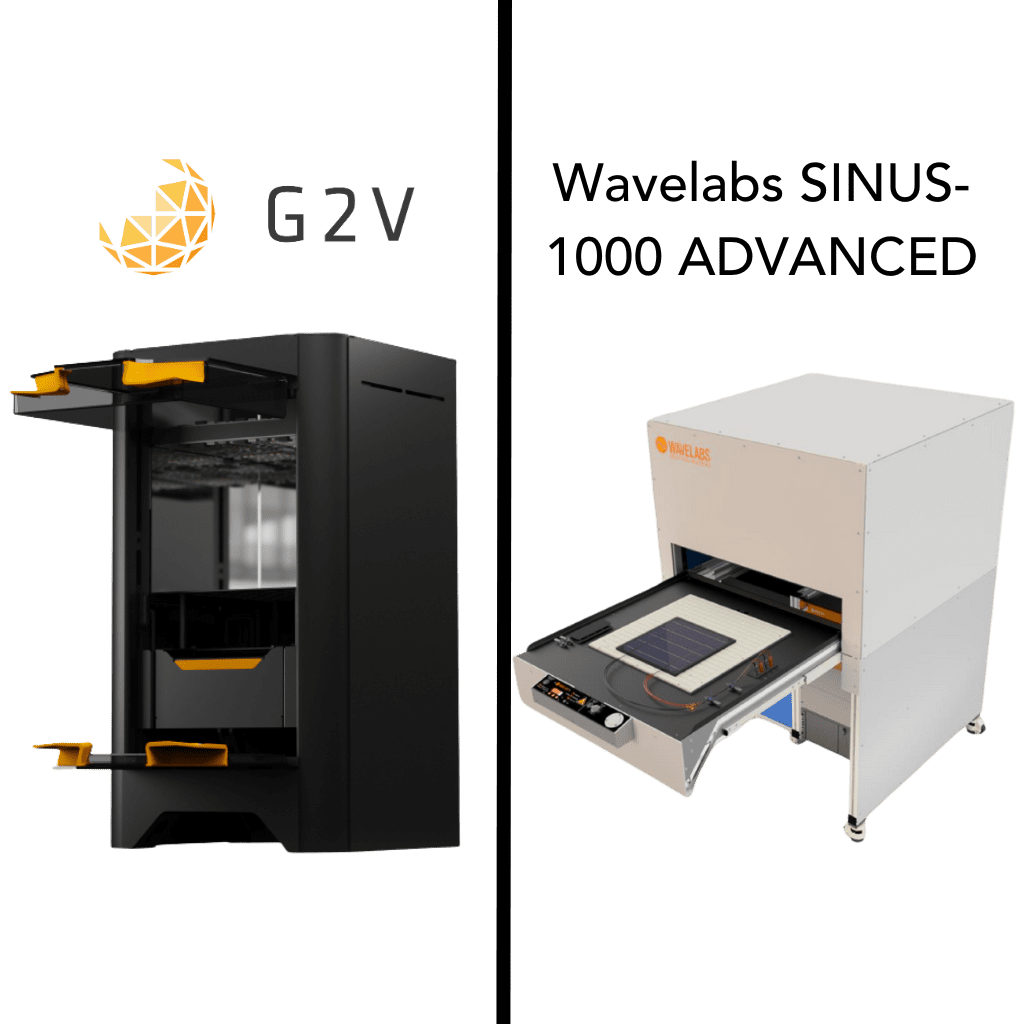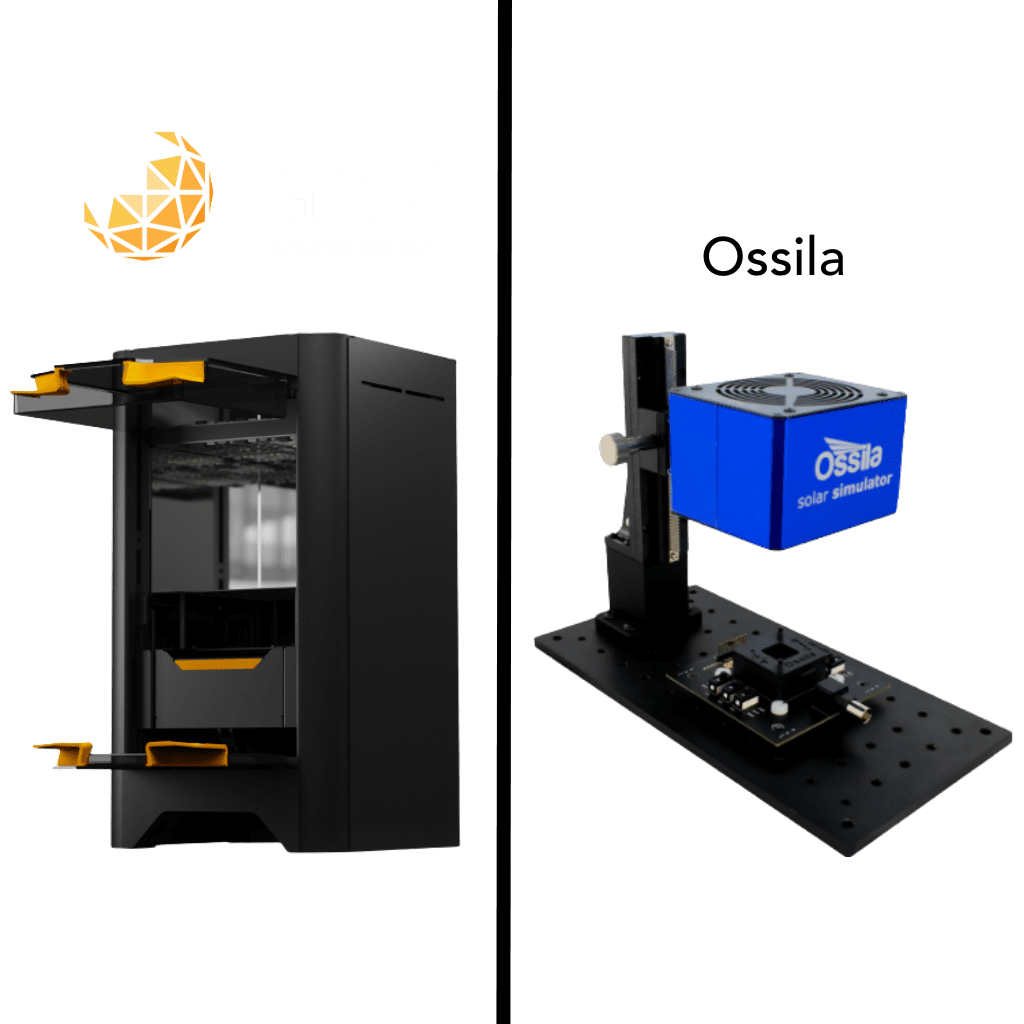

When precision matters, not all solar simulators measure up. This side-by-side look at the G2V Sunbrick and Ossila’s simulator highlights key differences in standards compliance, integration, and performance, so you can confidently choose.
| Feature | G2V Sunbrick | Ossila Solar Simulator | Questions To Ask Yourself |
|---|---|---|---|
| Area of Illumination | 15 cm × 15 cm (Class A+) | 15 mm diameter (Class A), up to 32 mm diameter (Class C) | Will my Device Under Test (DUT) increase in size as my research progresses? |
| Spectral Range | 350 nm – 1200 nm | 380 nm – 1000 nm | Do I need UV below 380 nm or NIR coverage beyond 1000 nm? |
| Spectral Control | 32 Tunable channels | 11 Tunable channels | What resolution in spectrum control do I want to future proof my experiments? |
| IEC 60904-9 Compliance | Class A+A+A+ | Class AAA | Do I need certified, high-accuracy performance over larger areas? |
| Spectral deviation (SPD) | <25% | <70% | Do I require light that closely matches the sun? |
| Spectral Match | < ±12.5% | < ±25% | Do I require light that closely matches the sun? |
| Long-Term Temporal Stability | <2% | <2% | How sensitive are my experiments to light stability over time? |
| Spatial Uniformity | <1% (15 cm) | <1% (1.5 cm) | Do I need consistent irradiance over the full sample surface? How will I know if my sample isn't being irradiated uniformly? |
| Lifetime | 10,000+ hours | 10,000 hours | Will long-term consistency reduce repeat testing or recalibration? |
| Software & API | GUI + Python API | Basic GUI with USB-C control | Will I need automation, scripting, or lab instrument integration? |
| Price Point | ~$56.00/cm^2 (Class A+A+A+ over 225 cm²) | ~$2,150/cm^2 (Class A over ~1.8 cm²) | Is a lower purchase cost with a higher cost/cm^2 worth limitations in precision, coverage, and automation? Do I know any colleagues or group labs who would pool money together for a higher-tier instrument? |
The G2V Sunbrick stands out with its expansive and scalable illumination area, extensive range of 350 nm – 1200 nm, and advanced spectral control with up to 32 tunable LED channels. Its compliance with Class A+A+A+ standards ensures high precision, making it ideal for sophisticated research requiring stringent testing conditions and integration with various lab instruments.
In contrast, the Ossila Solar Simulator offers a smaller footprint and is suitable for basic solar simulation needs. With a smaller illumination area and limited spectral range (380–1000 nm), it serves well for preliminary testing. Still, it may fall short for advanced research requiring broader spectral coverage, higher uniformity and real-world testing.
When choosing between the two, consider the need for a larger IEC standard-compliant area, integration capabilities with existing lab equipment, and enhanced spectral control and accuracy.


















When precision matters, “good enough” isn’t. Leading institutions in photovoltaics, materials science, and photochemistry choose G2V because their research demands light they can trust, not a filtered approximation.
Whether you’re:
Validating next-gen solar cells
Testing real-world conditions
Or creating new photocatalytic materials
The Sunbrick delivers Engineered Sunlight™ with complete control, no filters, no drift, no compromises.
Finding a consistent format of information comparing solar simulators and other alternatives isn’t easy. Our articles are designed to consolidate the information and keep you from needing to explore endless pages of search results
Knowledge Base
Explore our knowledge base to learn more about customers’ work in the STEM field, the IEC standards, and the physics properties of light and how they apply to different applications. Our knowledge base is designed to make finding information on solar simulation faster than light.
“Photocatalysis enables us to harness the energy generated by the Sun and convert it into chemical energy stored in hydrogen molecules. The produced hydrogen gas can be used as a clean, renewable fuel source that does not emit greenhouse gases or other...