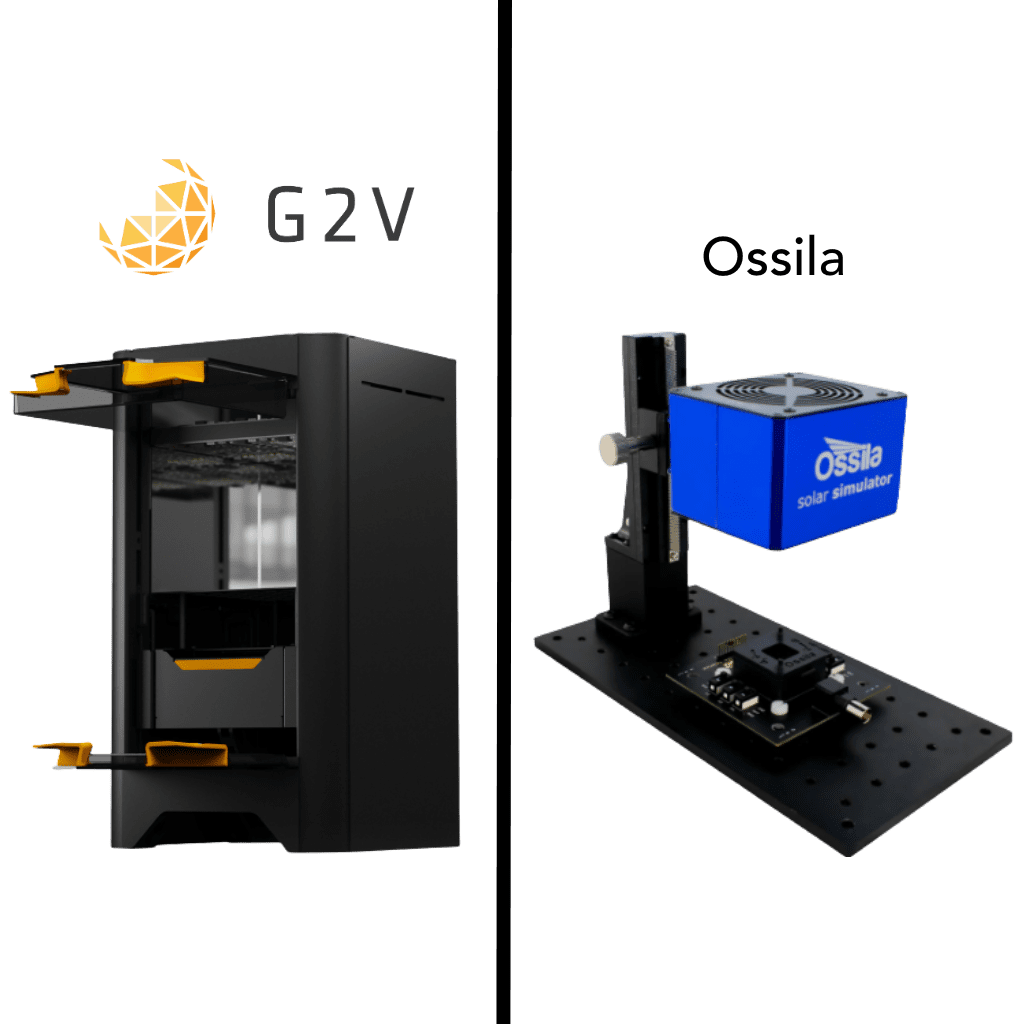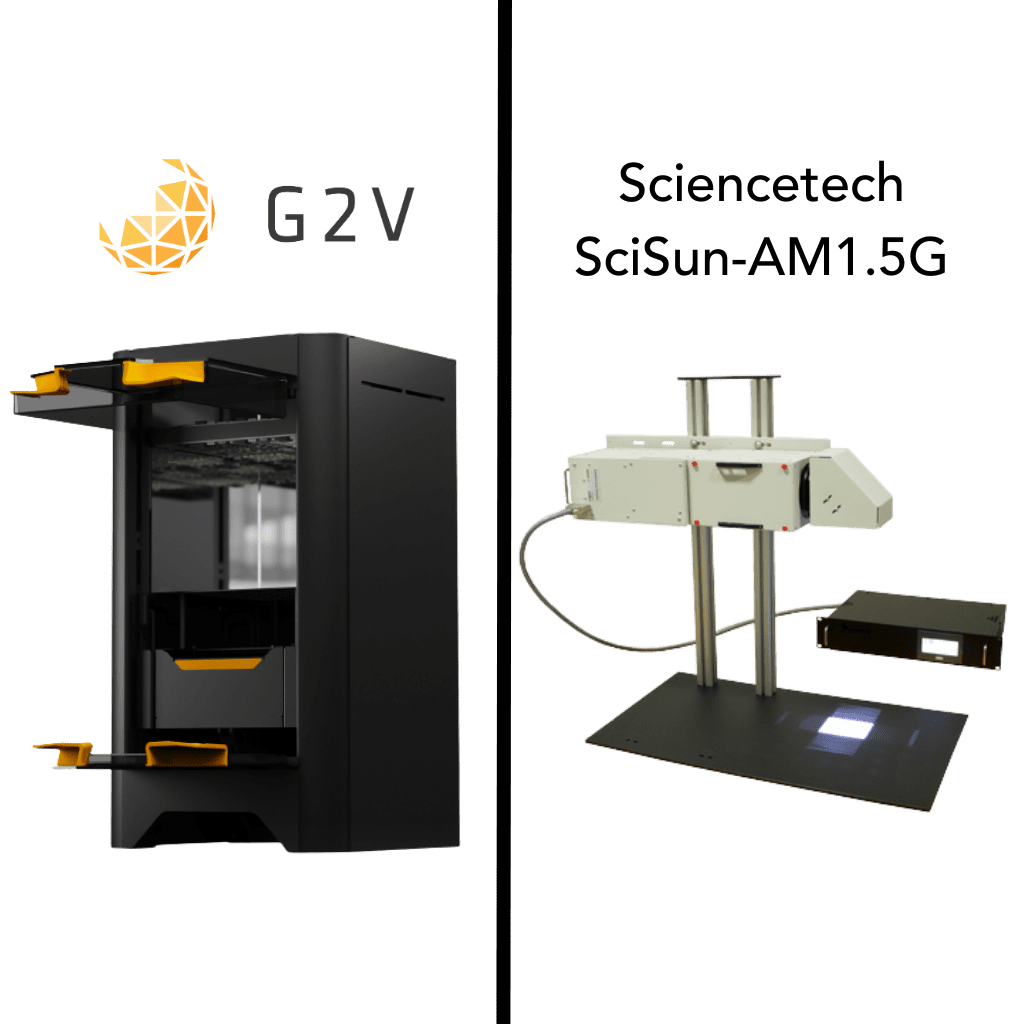
Not all light is equal, especially when it comes to scientific research. This side-by-side comparison of the G2V Sunbrick and a generic LED flood light highlights critical differences in spectral accuracy, stability, and test repeatability so you can choose a light you can trust.
| Feature | G2V Sunbrick | LED Flood Light | Questions To Ask Yourself |
|---|---|---|---|
| Area of Illumination | 15 cm × 15 cm | Varies, often non-uniform | Is your light evenly distributed across the sample area? |
| Spectral Range | 350 nm – 1200 nm | ~420 nm – 700 nm (Visible only) | Will I need UV or NIR coverage for future tests? What happens to my results if unknown key wavelengths are missing? |
| Spectral Control | 32 Tunable channels (explore a portion or all of the spectrum) | Fixed white spectrum | Can I match AM1.5G, AM0, or create a custom profile? |
| IEC 60904-9 Compliance | Class A+A+A+ | Not compliant | Do I need traceable, certifiable light for publication or QA? |
| Temporal Stability | <2% over 10,000 hrs | Unknown / unregulated | How much variation can my measurements tolerate? Will this variation give me wrong results? |
| Spatial Uniformity | <1% | Often poor, with hotspots and gaussian distribution | Does my data rely on even exposure across the sample? |
| Reproducibility | Day-to-day consistency | Inconsistent between units or batches | Will I get the same results next week or with a different light? |
| Spectral Standards | AM1.5G, AM0, Custom Profiles | None | Do I need to match solar reference standards for credible results? Does real-world implications matter to my research? |
| Automation and Integration | Python API, IV integration | None | Do I need to automate testing or control the light programmatically? |
| Safety and Contamination Risk | Controlled indoor environment | Designed for illumination, not contamination-sensitive setups | Will uncontrolled environmental exposure affect my data or samples? |
The differences go far beyond appearance when comparing the G2V Sunbrick to an off-the-shelf LED white flood light. While flood lights may offer initial cost appeal, they lack spectral coverage, stability, uniformity, and certification, posing significant risks to experimental repeatability and data integrity.
The Sunbrick, on the other hand, delivers a 15 cm × 15 cm Class A+A+A+ certified illumination area, programmable spectral tuning across 32 channels, and built-in integration with Python APIs and IV instrumentation. It’s engineered specifically for solar cell testing, sensor development, materials research, and other applications where the quality and consistency of light directly affect results.
If your work depends on trusted data, scientific repeatability, or real-world outcomes, a floodlight isn’t a valid substitute.
Unreliable spectrum: Flood lights are designed for human vision, not scientific accuracy. Their narrow visible output misses key UV and NIR wavelengths.
No standards compliance: These lights can’t meet IEC 60904-9 requirements, making your data unpublishable or non-compliant.
Inconsistent performance: Consumer LEDs vary between batches, and there are no guarantees on spectral shape, irradiance, or stability over time.
Hotspots and uneven light: Poor spatial uniformity introduces sample-to-sample variability and measurement errors.
No integration or control: You can’t automate, tune, or even dim them predictably; you’re limited to “on or off.”
Spectral precision: 32 tunable LED channels allow you to replicate AM1.5G or AM0 or create custom conditions tailored to your materials.
Certified Class A+A+A+ compliance: You get verifiable spectral match, uniformity, and stability for publication or QA.
Consistent, reproducible data: Each Sunbrick unit delivers stable irradiance with <2% drift over thousands of hours.
Designed for science: it features a Built-in Python API, IV instrument compatibility, and a glovebox-ready footprint that streamlines workflow.
Reliable light, on your schedule: 24/7 availability with no need for workarounds or DIY calibration.















Top research institutions and companies in photovoltaics, material science, and photochemistry trust G2V Optics to deliver light they can rely on. The risks of “good enough” lighting don’t hold up under peer review or precision measurement.
Whether you’re:
Validating solar cell performance
Exploring the next generation of materials
Or aiming to test real-world conditions
The Sunbrick gives you Engineered Sunlight without the DIY guesswork.
Finding a consistent format of information comparing solar simulators and other alternatives isn’t easy. Our articles are designed to consolidate the information and keep you from needing to explore endless pages of search results
Explore our knowledge base to learn more about customers’ work in the STEM field, the IEC standards, and the physics properties of light and how they apply to different applications. Our knowledge base is designed to make finding information on solar simulation faster than light.
In our modern era, nearly every industry has standards that set baselines for ensuring its associated products are safe and suitable to perform intended tasks. Solar simulation – reproducing sunlight – is no different, having standards that specify the requirements for solar simulators, and...